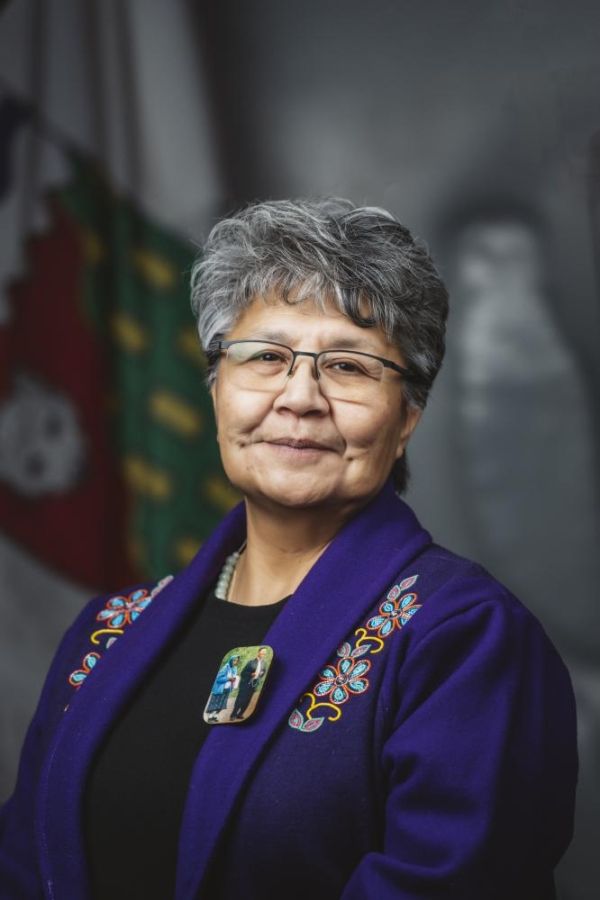
Jane Weyallon Armstrong

Member Monfwi

Jane Weyallon Armstrong was elected to the 20th Assembly to represent the constituency of Monfwi. Ms. Armstrong was elected to the 19th Assembly during a by-election to represent the constituency of Monfwi.

Ms. Weyallon Armstrong was born in Fort Rae, Northwest Territories. Currently residing in Behchoko, Northwest Territories, her impactful journey has left a lasting mark on her community.

Having served as President of the Native Women’s Association from 2019 to 2021, Ms. Weyallon Armstrong collaborated with board members on the National Inquiry into missing and murdered Indigenous women and girls final report. Her commitment to the cause has been a driving force in addressing crucial issues.

Ms. Weyallon Armstrong’s extensive involvement in community governance includes roles such as a Community Government of Behchoko Councillor (2009–2013, 2017–2021, June 2021 to July 2021) and Tlicho Government Assembly Member (Consensus Government) from 2009 to 2013. Additionally, she contributed by being on the Mackenzie Valley Impact Review Board from 2020 to 2021.

With a career spanning over 25 years at the Dogrib Divisional Board of Education (now Tlicho Community Services Agency), Ms. Weyallon Armstrong’s impact reached the lives of high school students from various communities. Her roles as Residence Manager and later as Coordinator, Community Liaison, and Student Transition Support Services showcased her dedication to education and community development.

Ms. Weyallon Armstrong’s educational journey includes graduating from Sir John Franklin Territorial High School in Yellowknife, where she resided at Akaitcho Hall. She earned a Bachelor of Arts with a Major in Politics and a Minor in Native Studies from the University of Saskatchewan. In 1994, she obtained her Social Work Diploma from Aurora College, Thebacha Campus, and in 1992, she earned her Child and Youth Care Worker Diploma from Mount Royal College.

Ms. Weyallon Armstrong, in partnership with her spouse, have raised their daughter, and now revel in the role of proud grandparents to a grandson. Ms. Weyallon Armstrong possesses a range of interests that extend to sewing, reading, and engaging in various cultural activities. Her longstanding commitment to volunteering for fundraising events and field trips underscores her dedication to community well-being.

Monfwi Electoral District

Committees

Jane Weyallon Armstrong
Monfwi
Member's Office

Yellowknife NT X1A 2L9
Canada

P.O. Box
1320
Email

Statements in Debates

Debates of , 19th Assembly, 2nd Session (day 134)

Thank you, Mr. Speaker. Will the Minister commit to providing Indigenousbased cultural relevant addiction treatment for any Indigenous NWT residents who request it? Thank you.

Debates of , 19th Assembly, 2nd Session (day 134)

Thank you, Mr. Speaker. This is reference to the last questions. Does NIHB cover the cost if someone from the NWT goes to another facility besides the five facilities identified?

Debates of , 19th Assembly, 2nd Session (day 134)

If an NWT resident wanted to refer themselves into treatment without a case worker assigned to them, will the GNWT cover this cost? Thank you.

Debates of , 19th Assembly, 2nd Session (day 134)

Thank you, Mr. Speaker. Does the GNWT have a partnership with an Indigenousbased addiction treatment facility for NWT residents? When will the GNWT have an Indigenousbased addiction healing treatment facility accessible to NWT residents? Thank you.

Debates of , 19th Assembly, 2nd Session (day 133)

Thank you. According to the 2021 Northwest Territories Housing Corporation Annual Report, rent arrears were forgiven in Behchoko and Whati. Why were no arrears forgiven in Wekweeti and for Gameti. Thank you.

Debates of , 19th Assembly, 2nd Session (day 133)

Thank you, Mr. Speaker. Mr. Speaker, as a method to reduce arrears, can the Minister commit to establishing a periodic verification of income options for tenants. Thank you.

Debates of , 19th Assembly, 2nd Session (day 133)

Mr. Speaker, majority of the people majority of the Indigenous people are living in public units; therefore, it is important for housing employees to be Indigenous. I want to ask the Minister what are they doing to build the capacity. What is the Housing NWT doing to build their capacity? Thank you.

Debates of , 19th Assembly, 2nd Session (day 133)

Thank you. What local housing organization staff training is required on culturally respectful communication and developing relationship with Indigenous people. Thank you.

Debates of , 19th Assembly, 2nd Session (day 133)

Mahsi, Mr. Speaker. [Translation] Mr. Speaker, what I am going to talk about is regarding housing in the Tlicho region, Behchoko, Whati, Gameti, and Wekweeti. And I'm going to talk about the rental prices. There's a lot of people that has debts with their rentals. And the whole process of rating their monthly rent. And sometimes some of these people are evicted from their units. I will be talking about that today. But today I want to talk about people's arrear and what happens to them in the future if they were to ask for a new rental again. So these are some of the questions I will be...

Debates of , 19th Assembly, 2nd Session (day 132)

Many Indigenous governments want to directly operate and manage their own rental properties but lack territorial or federal funding to subsidize these units so they are affordable to NWT residents. To increase housing options and support affordable housing, can Housing NWT commit to subsidizing Indigenous government owned rental properties as a part of their service provisions with Indigenous government? Thank you.