


Kate Reid

Member Great Slave

Kate Reid was elected to the 20th Northwest Territories Legislative Assembly to represent the constituency of Great Slave.

Ms. Reid was born in Oshawa, Ontario in 1981, and has called Yellowknife home since 1989. She holds a bachelor’s degree in journalism (Toronto Metropolitan University, 2003), and a master’s degree in information studies (University of Toronto, 2009).

After completing her master’s degree, she was grateful for the opportunity to work at the NWT Archives for nearly a decade, where she cultivated a deep appreciation for preserving and sharing the stories that define the territory and its government. Transitioning to the Department of Environment and Natural Resources in 2018, Ms. Reid focused on conservation and sustainable development issues in legislative and policy work prior to being elected.

Ms. Reid volunteered as President of YWCA NWT from 2021 to 2023 and served as UNW Local 40 President in 2019 and from 2021 to 2023. Her leadership extends to the cultural realm as a past director for Folk on the Rocks, Yellowknife’s long-running and beloved music festival. Ms. Reid has also contributed to community events such as NWT Pride and Yellowknife Pride, and the past springtime art spectacle, Burn on the Bay.

In her personal life, Ms. Reid is married and finds inspiration in an array of hobbies. She loves music, art, burlesque, drag, film, weightlifting, and travel.

Committees
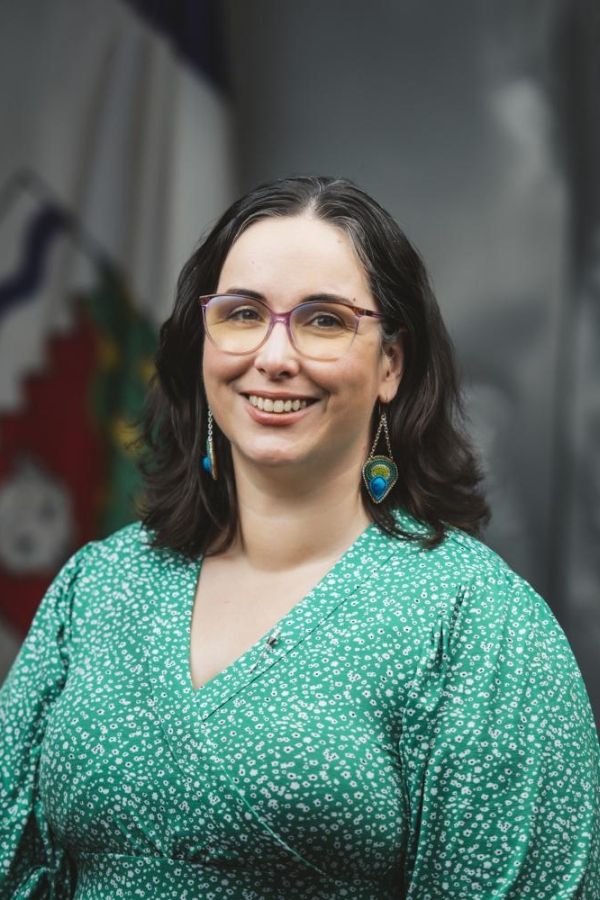
Kate Reid
Great Slave
Member's Office

Yellowknife NT X1A 2L9
Canada

P.O. Box
1320
Email
Extension
12186

Statements in Debates

Debates of , 20th Assembly, 1st Session (day 21)

Thank you, Mr. Speaker. Mr. Speaker, today I am joining many of my colleagues and will speak to the theme of housing.

Mr. Speaker, I believe that public housing can be a net good and benefit for our communities, but it must be supported within a framework that allows for collective pride and a cooperative approach. I also believe in providing smart investments into the maintenance of public housing such as retrofits and new builds as needed and where appropriate. But part of the problem here is that the fact that the federal government has continuously cut funding into public housing...

Debates of , 20th Assembly, 1st Session (day 21)

Thank you, Mr. Chair. And, really, just one more question. Can the Minister speak to the engagement and promotion and discussions in a general way. I don't want her, you know, speaking to anything confidential, really. It's just, as she noted, I am super keen to see where ECE can go with this, and I'm interested to see where ECE can go with our federal partners on this and looking at those new pathways. So is there anything she can speak to on timelines or big dreams she might have, Mr. Chair. Thank you.

Debates of , 20th Assembly, 1st Session (day 21)

Thank you very much, Mr. Chair. So excuse me for one quick second here as I find the pages on the business plan I'd like to refer to quickly.

In the business plan on page 15, the department speaks to supporting pathways to employment for NWT youth through SNAP and specifically talks about measures of number of high school students participating in SNAP program as students.

I don't have any particular issue with that but what I would like the Minister to speak to is if her department has thought about other pathways to career education within the JK to 8 segment. I heard a lot from folks on the...

Debates of , 20th Assembly, 1st Session (day 21)

Thank you, Mr. Chair. So just to clarify, then, can the Minister explain if she expects to need more than what is currently funded? Thank you, Mr. Chair.

Debates of , 20th Assembly, 1st Session (day 21)

Thank you, Mr. Chair. So as my colleague from Monfwi has spoken to, very passionately in this House on many a time, there is a concern, I think, around the lack of funding for the senior home heating subsidy. So especially for elders who are on limited incomes. And I can see that in the main estimates from 20232024 and the revised estimates, there is a difference of approximately 500 and change thousand dollars, and now the main estimates for 20242025 have gone back down. Does the Minister wish to speak to whether she thinks that's adequate? Thank you.

Debates of , 20th Assembly, 1st Session (day 21)

Thanks, Mr. Chair. That's a nice shout back to Minister of Justice for more French translating drafters.

I'm curious around specifically, you know, what we're going to be asking of our workforce in the early childhood operator piece, especially around some of the asks for their education. And so does the Minister know when that piece will be out for public engagement in hopefully this year, Mr. Chair. Thank you.

Debates of , 20th Assembly, 1st Session (day 21)

Okay. I'll leave it at that. Thank you, Mr. Chair.

Debates of , 20th Assembly, 1st Session (day 21)

Thank you, Mr. Chair. Mr. Chair, can the Minister please tell me how far along the department is into developing regulations for daycare workers under the $10aday program, please. Thank you.

Debates of , 20th Assembly, 1st Session (day 21)

Thanks. And I guess I wasn't really clear. So I'm thinking more along  not necessarily along the programs and services of Indigenous and French languages supported by ECE but, rather, what does that support system look like going into the future with these two secretariats and possibly a new ADM? I know the new president of Aurora College was the ED, I believe, of the Indigenous language secretariat. I'm not sure if ECE has found a replacement for that position, if that is being contemplated or if we're going along with the secretariat structure. Just wanted some more clarity around that...

Debates of , 20th Assembly, 1st Session (day 21)

Thank you, Mr. Speaker. And I look forward to hearing more about that engagement once it gets going.

Mr. Speaker, I know the previous Assembly also worked with Housing NWT to review their policies in an allencompassing way. Can the Minister explain if Housing NWT is considering the contemporary issue of homelessness through the lens of the ongoing effects of colonialism given that Indigenous people are disproportionately represented in those experiencing a lack of housing? Thank you.