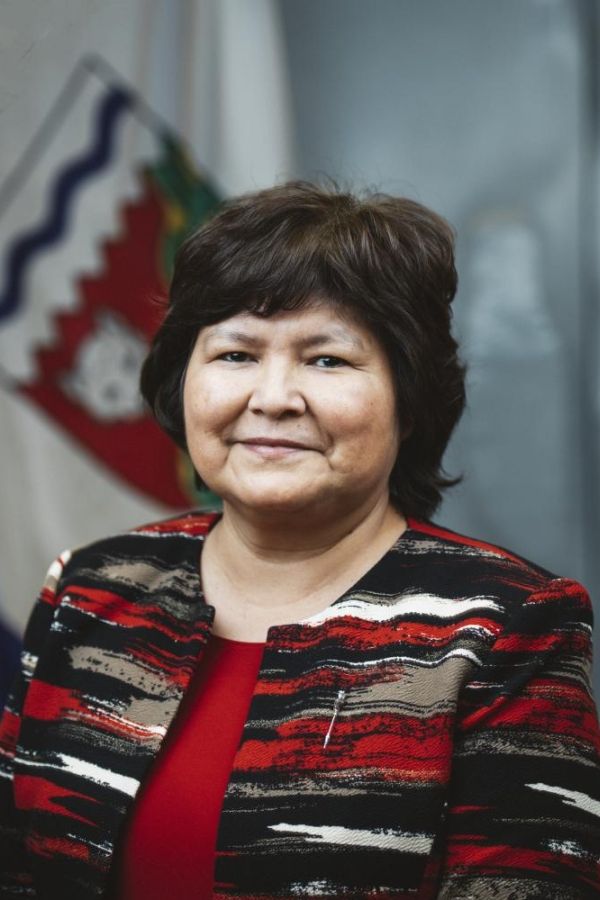
Thank you Mr. Speaker. Mr. Speaker, Members will note, my colleague from Range Lake made reference to the Olympics, I am wearing my Team Canada colours today. Certainly appreciated seeing our men's hockey team win yesterday and I look forward to watching our women tomorrow morning and wish them all the best. But I thought I'd wear a bit of a thematic outfit today. So getting to my reply to the budget address.
Mr. Speaker, as we have been considering our 2026 Budget, the theme of both the budget address itself and the replies to it have focused on whether we are adequately responding to the challenges we're facing. As the Member for Inuvik Boot Lake put it, are we meeting the moment?
And Mr. Speaker, those challenges are many. We have a healthcare system being increasingly squeezed by national shortages of health care practitioners, cuts to integral programs like Jordan's Principle, rising debt, shrinking revenues, and increasingly difficult global market conditions leading to early closure of the mines that form the backbone of our economy, to name just a few. These certainly are difficult times we're facing.
How are we going to meet these challenges? I think we're all feeling the weight of this question, Mr. Speaker. I certainly know I am. And there's been a palpable sense of heaviness in this building, indeed in the world, as we delve into 2026.
Where I think we can find some comfort, Mr. Speaker, is in knowing that we are not facing these challenges alone. We bear this weight together. And in working together, we can take full advantage of our collective strengths. I think that is where the true potential of consensus government lies, and so I offer my reply to the budget address in the spirit of collaboration between Regular Members and Cabinet that our system is designed to uphold.
Working together is not always easy. And it is made more difficult still, because the structure of our system splits us into two different sides, which creates a system of accountability but it also naturally creates conflict.
Mr. Speaker, when I was studying conflict and analysis management, one of the case studies that was presented to our class was one where researchers took two groups of students and split them into two teams. They pitted those teams against each other. They were two camps. It was two summer camps, And they split those camps together and created competition for them to start to compete over each for resources. In that competition, researchers found that the camps quickly descended into tribalism, demonizing each other, fighting. And they observed both camps independently, and in both camps found that they increasingly started to identify strong differences and have difficulty seeing the other as being valuable, as being people who had good ideas. And then the researchers created a common problem that the camps had to fix. And they found that quickly, the demonization that had previously been occurring started to go away. The camps identified common interest. They started to see each other as teammates. And they worked together towards that common goal. And the animosity that had been building between them, simply because they were divided, started to disappear.
I bring this up, Mr. Speaker, because I think it's easy to get caught up inadvertently in tribalism when we are split apart by structure. I think we sometimes do it without even realizing it.
From the Cabinet side, I would imagine that Ministers look at us and feel frustration that it seems like we're asking for everything all at once; That if you did everything we were asking for, spending would be even more out of control than it is. And I acknowledge we do sometimes struggle to coalesce around common ideas. But we have also come together on the most major challenges facing our territory and pushed for change that reflects the priorities we all set together.
And Regular Members certainly can't be blamed for all our budgetary woes. In my short time in this Assembly, I've watched Cabinet struggle to curb spending and stick to their own stated policies. I've watched contracts double year over year. Projects escalate exponentially in cost without changing in scope.
Mr. Speaker, just yesterday, as we were reviewing the strategic infrastructure budget, it was revealed that we have spent more than $60 million collectively on advancing three major projects and have not yet finalized a project description for any of them let alone successfully brought any of them through environmental assessment. Neither of our sides are perfect, Mr. Speaker.
And so I would encourage Members to reflect on this and the phenomenon of how our thinking changes when we are split into separate sides and consider whether we are approaching each other with truly open minds and with the humility and strength of character to admit our shortcomings, to open ourselves to ideas of how to do things differently or better, and acknowledge that there isn't a single one of us who holds all the answers but together as a team, we have a lot of strength and ability.
Recently I got a chance to cross the floor, so to speak, and travel to the Roundup conference with some of my Cabinet colleagues, as the previous Speaker mentioned. As I noted in a previous statement, I was impressed by the time and dedication they put into fighting for our territory. I will admit I felt a bit out of place at times. I was mostly there in an observer role. It's not my job to be a Cabinet Minister. And so I found myself reflecting on the role I do play in this system and how it relates to theirs.
It was clear to me that our Ministers are extremely busy and don't have the time that Regular MLAs do to dive into issues in detail, identify gaps in what we're doing to advance our priorities, and focus on the things that they can't. In doing that work, Regular MLAs play an integral role in our system and can bring a lot of value to it. And so I am committed to doing just that, Mr. Speaker.
So I hope that by setting out all this context, it will help my Cabinet colleagues see that when I critique and question and bring ideas to the table, it is in the spirit of helping, of contributing what I can in my role to help us achieve our collective goals. With all of that said, I turn to the budget.
Firstly, I want to acknowledge the good. Cabinet has brought forward a vision that focuses heavily on advancing major infrastructure projects from the beginning of this Assembly, Mr. Speaker. Indeed, at this point, we have not one but two infrastructure Ministers. So in terms of identifying gaps, I won't speak to infrastructure much today because I think it is already a key focus of our government, and our needs and deficits have been spoken to at length already. I can say that I see myself and things I've been advocating for in some of the changes that have come forward in this budget. Changes to improve access to laboratory services in our hospital, an increase to IRMA funding to help advance our regulatory priorities, additional staff to move land transfer forward. I commend Cabinet in bringing forward these ideas and pleased to see these changes and excited to build upon them.
In our letter to the finance Minister, Regular MLAs advanced ideas that I agree with and contributed to, which address some of the gaps that we see in our plans and areas that we feel need more attention. I think it's important to let that letter speak for itself, but I will highlight some of the areas I agree with most and where I think we need to be going.
To sum up the themes, where I think we need changes or more focus on health care, economic development, education, and leadership.
Health care.
To put it succinctly, we need to focus our efforts on strengthening the foundation of our system from which all of our other health care goals and priorities will flow. We need to focus on stabilizing the workforce so we can achieve our goal of increasing access to primary care and to clearly state our goals for what we mean when we say increasing access. Goals which are simple and easy for the public to understand, such as addressing wait times and access to continuity of care from a primary care team whom they can book appointments with in a timely manner. It really needs to be that simple, Mr. Speaker. Though I know that getting us there is not a simple task by any means, I think by focusing on these fundamentals and on the foundation, as we set our priority, access to care, that is how we will achieve our wider goals, our greater goals for the system that the Minister has been communicating.
Economic development.
Mr. Speaker, I have spoken extensively in my opinion that we need to tie education and economic development together and they are intertwined and they need to be thought of together when we are planning.
Mr. Speaker, our economy is not going to be the same as it has been for the past 25 years. We have benefited from a huge boom that the diamond mines created, but I think we need to acknowledge and face, as it's been said with eyes wide open, that no single thing is going to replace the diamond mines. That panacea is not coming and we need to face it. We need to face it soberly.
But we should also note that for the past 25 years, this territory has been blessed with a double-edged sword of more development than we even had the capacity to truly take advantage of. 60 percent of employment at the diamond mines throughout their lives has been southern. In part due to the fact that devolution took place so late in the mines' life, we captured a fraction of 1 percent of the profits from those mines in our heritage fund. So as much as we have benefited from the mines, we also saw much of the potential benefits fly right over our heads and out of the territory. While that story is tragic in one sense, it also gives me a certain amount of comfort that if we truly put our efforts towards diversification and better capturing the benefits of development that is coming in the future, we are going to be okay. As was just pointed out, the small size of our population in comparison to our landmass is one of the greatest challenges and also a source of opportunity.
On one hand, we have a massive wealth of natural resources to benefit from if we manage and develop them responsibly. And on the other, we only need to employ the population of a small city at the end of the day. 45,000 people, Mr. Speaker.
So I support what we're doing with regards to infrastructure and I want to see us diversifying our economy. So I am going to turn to education, which has been a focus of mine from the beginning.
On education, we need to start with a foundation. I believe that foundation starts with literacy. Without that fundamental building block upon which learning is built, our students will not have the fundamental skill they need to succeed in school. Building from there, we need to ensure that students are supported throughout their time in secondary school so that they can have the skills that they need to pursue post-secondary education, to build up their ability to participate in our economy.
Mr. Speaker, to put it simply, we need a polytechnic university that is leading the charge on educating people throughout our communities, giving them the skills to benefit from a growing economy and build themselves up. A post-secondary system anchored in our three campus communities and delivering programming to students throughout the territory could be a part of the transformative change that Members are so desperately seeking when they stand up and speak in this House about creating opportunities for their people and, most importantly, for our youth, the generation of people who are going to inherit the results of what we do or do not build today. So let's invest in them, Mr. Speaker. Not just in our infrastructure, but in our people.
I will keep repeating that our people are the greatest resource this territory has to offer, because I know that it's true. So when I hear Members speak about how they want to see opportunities for their people to lift themselves up in this budget, to be educated and have good career opportunities, I can wholeheartedly support that, and I want that for my community, too.
The last item I want to speak to, Mr. Speaker, is leadership. On this item, when we're trying to advance ideas, when we're working with Cabinet and when we're bringing questions to the table, to the floor of this House, I keep hearing, well, Mr. Speaker, we're working with our partners, we're working to advance ideas, this is something that's in someone else's control. Mr. Speaker, if someone isn't stepping up and taking the lead, who else is going to step in if not us?
It's 2026. Diamond Mine closures aren't something that have hit us unexpectedly. The first one was planned for this year and has been planned for 25 years.
I sometimes find myself frustrated. How are people just waking up to this challenge now? I started speaking about the need to diversify our economy and build a polytechnic university to try and build up the economy of this territory outside of just mining back in 2015 when I first ran for council. And I often hear criticisms of the Legislative Assembly well, they haven't been talking about these problems. Whenever I hear that, I feel a bit frustrated because it's all I've been talking about as a politician for 11 years going now. I will keep trying. I will keep repeating that message.
So what I would encourage our leaders to do, and encourage us to continue to do, is imparting a sense of urgency. This territory does need leadership.
I spoke last year to attending the Indigenous economic development conference and I noted then that a lot of what I heard at that conference was people frustrated with the GNWT and what the GNWT wasn't doing. So people are looking to us for leadership. We do have to work with our partners. We have to work in concert with them. But at the tables that we're working with them in, I think that we can establish timelines, we can impart a sense of urgency, and we can help everyone coalesce together around the ideas that we've come up with to help grow our economy and to build up this territory, and we can be a force that brings those voices together and moves us in the right direction.
I acknowledged in a previous statement that in some ways I see us doing that. I spoke to the agreement that was signed at Roundup. I've spoken to the work that we've been doing to advance that, and I strongly encourage us to continue doing that. And I would double down and say that at the tables where we're working together, we need to communicate the sense of urgency and help the governments that we're working with, some of which are challenged with capacity, to move forward. So that's why I think things like investing in IRMA funding are really important, because it helps us do just that. And I would encourage us to go even further. I would encourage us to look at the Intergovernmental Council table and what we can do to build up the capacity of that system so that we can move so many of our priorities that run through that system forward.
We have to acknowledge, Mr. Speaker, that we are stronger together. As much as I've spoken today about our two sides working together, I feel the same way about the people of our territory, of all the various governments that are working together to advance the goals of this small municipality with a land mass bigger than most other countries in the world.
Mr. Speaker, we are certainly stronger together, and together we can succeed. But we run the risk of failing together too, if we can't come together and meet the moment. So I encourage us to all double down on our efforts, to set our differences aside, to work together. I encourage Cabinet to listen to the ideas, acknowledge them, and approach them with open minds that AOC is bringing to the table. And I think that together we have the best chance of succeeding. Those are my comments on the budget address, Mr. Speaker. Thank you.