


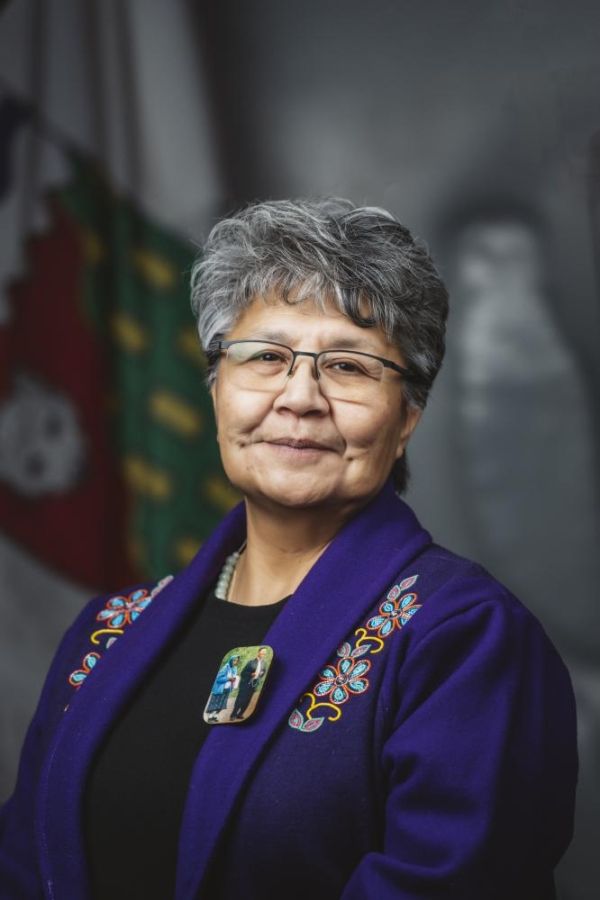
Jane Weyallon Armstrong

Député de Monfwi

Circonscription électorale de Monfwi

Jane Weyallon Armstrong a été élue députée de la circonscription de Monfwi à la 20e Assemblée législative des Territoires du Nord-Ouest. Jane Weyallon Armstrong a été élue à la 19e Assemblée lors d’une élection partielle pour représenter la circonscription de Monfwi. 

Elle est née à Fort Rae, aux Territoires du Nord-Ouest. Résidant actuellement à Behchoko, aux Territoires du Nord-Ouest, son parcours a laissé une trace indélébile dans sa collectivité. 

Ayant été présidente de l’Association des femmes autochtones de 2019 à 2021, Jane Weyallon Armstrong a collaboré avec les membres du conseil d’administration sur le rapport final de l’Enquête nationale sur les femmes et les filles autochtones disparues et assassinées. Son engagement pour la cause a joué un rôle majeur dans la résolution de problèmes cruciaux. 

La riche participation de Jane Weyallon Armstrong à la gouvernance de la collectivité comprend des rôles tels que conseillère à l’administration communautaire de Behchoko (2009-2013, 2017-2021, juin et juillet 2021) et membre de l’assemblée du gouvernement tłı̨chǫ (gouvernement de consensus) de 2009 à 2013. En outre, elle a siégé à l’Office d’examen des répercussions environnementales de la vallée du Mackenzie de 2020 à 2021. 

Avec une carrière de plus de 25 ans au Conseil scolaire de division des Dogrib (aujourd’hui l’Agence de services communautaires tłįchǫ), Jane Weyallon Armstrong a eu une incidence positive sur la vie d’élèves du secondaire issus de diverses collectivités. Ses fonctions de directrice de résidence, puis de coordonnatrice, d’agente de liaison et de responsable des services aux étudiants et d’aide à la transition après les études ont mis en évidence son dévouement à l’éducation et au développement de la collectivité. 

Jane Weyallon Armstrong a fait ses études secondaires à l’École Sir John Franklin à Yellowknife, et résidait à l’Akaitcho Hall. Elle a décroché un baccalauréat ès arts avec une majeure en politique et une mineure en études autochtones à l’université de la Saskatchewan. En 1994, elle a obtenu un diplôme de travailleuse sociale au Collège Aurora, au Campus Thebacha, et en 1992, un diplôme d’assistante sociale auprès des enfants et des jeunes au Mount Royal College. Jane Weyallon Armstrong a élevé sa fille avec son conjoint et se réjouit aujourd’hui d’être la fière grand-mère d’un petit-fils. Elle s’intéresse à la couture et à la lecture et participe à diverses activités culturelles. Son engagement de longue date en tant que bénévole pour des événements de collecte de fonds et des sorties scolaires souligne son dévouement pour le bien-être de la collectivité.

Committees
Jane Weyallon Armstrong
Monfwi
Bureau

Yellowknife NT X1A 2L9
Canada

P.O. Boîte
1320

Déclarations dans les débats

Debates of , 20th Assembly, 1st Session (day 75)

Well, it's good the program is being reviewed, the policy is being reviewed, because it's the policy. I like the program. I understand about all the program that's available to help homeownership or to have more homeownership.

Given that the homeownership initiative policy is a policy that does not identify the core need income threshold as an eligibility requirement, what internal direction or guidance led to its use in assessing applicant eligibility? Thank you, Mr. Speaker.

Debates of , 20th Assembly, 1st Session (day 75)

Thank you, Mr. Speaker. Mr. Speaker, the auditor general's report shows that housing issues have persisted for over a decade with little progress. How will the Minister ensure accountability and deliver a clear, measurable plan to address overcrowding, improve housing quality, and prevent this crisis from continuing for another generation. Thank you.

Debates of , 20th Assembly, 1st Session (day 75)

Thank you, Mr. Speaker. Mr. Speaker, my question is for housing. Mr. Speaker, GNWT received various auditor general's reports, education, social program, and housing all gave a failing grade. With that in mind, Mr. Speaker, Tlicho region is in housing crisis with severe overcrowding in Tlicho communities. What immediate steps is the Minister of Housing NWT taking to build new houses in the Tlicho region rather than relocating families to Yellowknife. Thank you.

Debates of , 20th Assembly, 1st Session (day 74)

Thank you, Mr. Speaker. Many elders are being denied the subsidy despite being just over the income threshold, yet they still struggle to afford heating their homes. Will the Minister consider creating a hardship provision or flexible reassessment process for seniors who narrowly exceed the threshold but clearly face heating insecurity? Thank you.

Debates of , 20th Assembly, 1st Session (day 74)

Masi, Mr. Speaker. Mr. Speaker, my questions are for the Minister of Education, Culture and Employment.

Mr. Speaker, seniors on fixed incomes in our small communities are telling me that the current income threshold for the seniors' home heating subsidies and other program as well is simply too low to reflect the real cost of living. Will the Minister commit to reviewing the income threshold to ensure it better aligns with the true heating costs faced by seniors in smaller communities. Thank you.

Debates of , 20th Assembly, 1st Session (day 74)

Thank you. Mr. Speaker, this is questions for -- regarding heating subsidy program for seniors.

So many of our senior citizens living in small communities do not have the luxury of relocating or moving south of the border where cost of living is less. Will the Minister commit to lifting income thresholds for programs such as heating subsidy for senior citizens over 65 years of age in the NWT? Mr. Speaker, I'll tell you in small communities, you will not find senior citizens living on $200,000 a year pension. Thank you.

Debates of , 20th Assembly, 1st Session (day 74)

Thank you, Mr. Speaker. Mr. Speaker, the cost of heating fuel, electricity, and home maintenance continues to climb faster than many fixed incomes can keep up. Can the Minister commit to introducing an automatic cost of living adjustment to the subsidy income thresholds so elders are not left behind when northern costs of living rise year after year. Thank you.

Debates of , 20th Assembly, 1st Session (day 74)

Thank you, Mr. Speaker. Mr. Speaker, [Translation] This item I am going to talk about is regarding how the senior citizen are helped and supported.?? When an elder makes a certain amount of money, they are not helped, but in all the regions, the elders have been telling us that everything is so expensive.?? So that's what I am going to talk about.??[Translation Ends]. Thank you, Mr. Speaker.

Mr. Speaker, eligibility requirements of the seniors' home heating subsidy continues to disadvantage many elders in our smaller communities. While the program is intended to support low to modest income...

Debates of , 20th Assembly, 1st Session (day 74)

Mr. Speaker, you know, many of our senior citizens in small communities, they're not going to go anywhere. They're not going to move away from their respective communities because they have families there. They have their culture, their language. So a lot of them are going to be -- are going to remain in their communities. So for that reason, that's why I was asking that if the Minister can commit or work towards to lift the income threshold instead of all these programs that the elders have to go through. Thank you.

Debates of , 20th Assembly, 1st Session (day 73)

Thank you, Mr. Speaker. Mr. Speaker, given the harm that denialist's statements can cause to survivors and their families, what additional supports or engagement will the Government of the Northwest Territories provide to ensure that survivors in the Northwest Territories feel heard, respected, and protected when other jurisdictions undermine or challenge the realities of the residential school system? Thank you.