


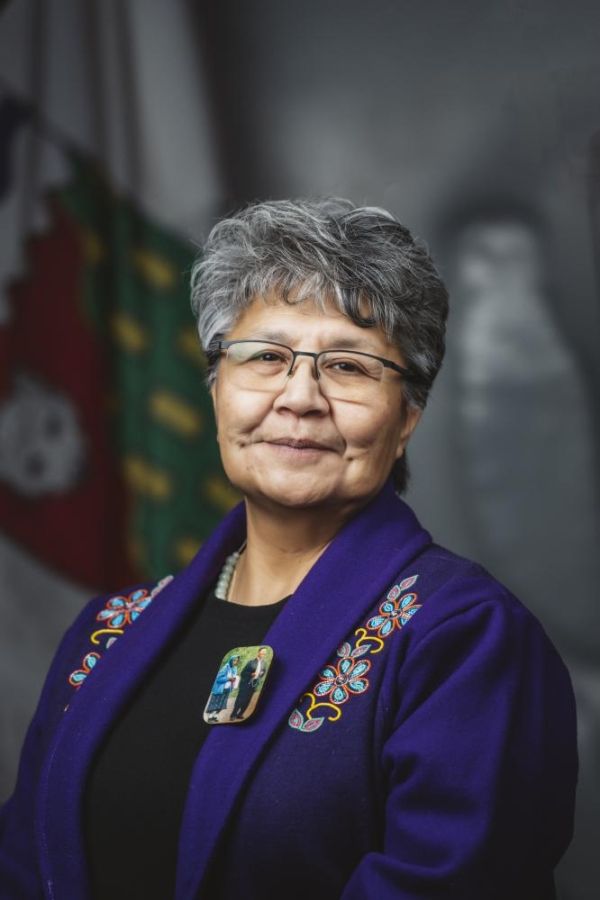
Jane Weyallon Armstrong

Député de Monfwi

Circonscription électorale de Monfwi

Jane Weyallon Armstrong a été élue députée de la circonscription de Monfwi à la 20e Assemblée législative des Territoires du Nord-Ouest. Jane Weyallon Armstrong a été élue à la 19e Assemblée lors d’une élection partielle pour représenter la circonscription de Monfwi. 

Elle est née à Fort Rae, aux Territoires du Nord-Ouest. Résidant actuellement à Behchoko, aux Territoires du Nord-Ouest, son parcours a laissé une trace indélébile dans sa collectivité. 

Ayant été présidente de l’Association des femmes autochtones de 2019 à 2021, Jane Weyallon Armstrong a collaboré avec les membres du conseil d’administration sur le rapport final de l’Enquête nationale sur les femmes et les filles autochtones disparues et assassinées. Son engagement pour la cause a joué un rôle majeur dans la résolution de problèmes cruciaux. 

La riche participation de Jane Weyallon Armstrong à la gouvernance de la collectivité comprend des rôles tels que conseillère à l’administration communautaire de Behchoko (2009-2013, 2017-2021, juin et juillet 2021) et membre de l’assemblée du gouvernement tłı̨chǫ (gouvernement de consensus) de 2009 à 2013. En outre, elle a siégé à l’Office d’examen des répercussions environnementales de la vallée du Mackenzie de 2020 à 2021. 

Avec une carrière de plus de 25 ans au Conseil scolaire de division des Dogrib (aujourd’hui l’Agence de services communautaires tłįchǫ), Jane Weyallon Armstrong a eu une incidence positive sur la vie d’élèves du secondaire issus de diverses collectivités. Ses fonctions de directrice de résidence, puis de coordonnatrice, d’agente de liaison et de responsable des services aux étudiants et d’aide à la transition après les études ont mis en évidence son dévouement à l’éducation et au développement de la collectivité. 

Jane Weyallon Armstrong a fait ses études secondaires à l’École Sir John Franklin à Yellowknife, et résidait à l’Akaitcho Hall. Elle a décroché un baccalauréat ès arts avec une majeure en politique et une mineure en études autochtones à l’université de la Saskatchewan. En 1994, elle a obtenu un diplôme de travailleuse sociale au Collège Aurora, au Campus Thebacha, et en 1992, un diplôme d’assistante sociale auprès des enfants et des jeunes au Mount Royal College. Jane Weyallon Armstrong a élevé sa fille avec son conjoint et se réjouit aujourd’hui d’être la fière grand-mère d’un petit-fils. Elle s’intéresse à la couture et à la lecture et participe à diverses activités culturelles. Son engagement de longue date en tant que bénévole pour des événements de collecte de fonds et des sorties scolaires souligne son dévouement pour le bien-être de la collectivité.

Committees
Jane Weyallon Armstrong
Monfwi
Bureau

Yellowknife NT X1A 2L9
Canada

P.O. Boîte
1320

Déclarations dans les débats

Debates of , 20th Assembly, 1st Session (day 82)

Thank you. Thank you, Mr. Chair. Thank you. Mr. Chair, it is a shame, you know, SFA policy is holding our Indigenous students hostage, fund them only when -- you know, if they are taking Aurora College bridging program. But it's something that we need to work on to improve. Yes, there's a lot of improvement made. You know, like student loans was increased from 60 to 90,000, and at the same time and just like the Minister said, okay, the -- for basic and supplementary funds have been, you know -- there was some improvement made. But living in the Northwest Territories, to rent -- the rent are -...

Debates of , 20th Assembly, 1st Session (day 82)

Thank you. These are mental health workers. We know that it's really greatly needed. And at one time, we had a lot of mental health workers. And I know some of them took courses to get into that field, and especially in small communities. And it's kind of sad because when we were still there, there was a lot of good mental health workers, community mental health workers where some of them took early retirement because they were laying off people due to education level. They were looking for people with Master's in mental health. They were looking for doctors. And since that time, did the...

Debates of , 20th Assembly, 1st Session (day 82)

Thank you, Mr. Speaker -- Mr. Chair. I don't mean to discredit the students because I know there's a lot of young people from my region that are taking business administration program and they're taking the nursing programs. I really do appreciate, you know, they're making every effort so that they don't be -- you know, so that they don't depend on the system to survive. And I really do appreciate their choice. But I am just asking that to fund the bridging program -- you know, like, it shouldn't be only -- the bridging program should not be only to the Aurora College should take the OCAP...

Debates of , 20th Assembly, 1st Session (day 82)

Thank you, Mr. Speaker. Mr. Speaker, what has the GNWT done to prepare for the potential economic and population impacts that experts warn could follow mine closures, especially in our smaller regional communities? Thank you.

Debates of , 20th Assembly, 1st Session (day 82)

Okay, thank you. Can the Minister explain? Because I think she said it's free to students. How is it? If she can explain that, I will -- you know, then I will let our young people know that it is free to take the upgrading program or the bridging program, but OCAP and UCAP is a bridging program. You know that, and I know that. So how is it free? Because the students have to pay for their tuition, their books, and everything. So if she can explain that, I would really appreciate that. Thank you.

Debates of , 20th Assembly, 1st Session (day 82)

Thank you, Mr. Speaker. Mr. Speaker, many of my constituents are nervous at this time with mine closure because this will have an impact on their livelihood. So with that in mind, Mr. Speaker, I want to ask the Minister of ITI what specific long-term diversification initiatives is the department developing to ensure sustainable employment opportunities for regions like the Tlicho once Ekati and Gahcho Kue cease operations. Thank you.

Debates of , 20th Assembly, 1st Session (day 82)

Thank you. We shouldn't have to be going through supplementary budget. It should be part of the main estimates, knowing that this is a very important program. You know, we know why JP program exists. And for so long, our students have been at disadvantage. So I just want -- that's the reason why I am asking is that why -- like, it's not part of it. And I think from here on -- I hope that the ECE department will put this in their main estimates knowing that things are changing in many of the small communities. There's many of our -- are undiagnosed and, you know, we need more workers to be...

Debates of , 20th Assembly, 1st Session (day 82)

Oh, sorry. Okay, JK to grade 12 student services, the revised estimate is $23 million compared to the upcoming fiscal year, $8 million. This 23, is that a reflection of the JP program? Thank you.

Debates of , 20th Assembly, 1st Session (day 82)

Okay. Application basis. So who does apply? Like, is it the Indigenous government and/or is it education council or education authority? Thank you.

Debates of , 20th Assembly, 1st Session (day 81)

Thank you, Mr. Speaker. Mr. Speaker, I was speaking for the whole of the Northwest Territories. There's 9,400 people that are affected. I wasn't speaking specifically for Tlicho region, but thank you for the information.

So what new or upcoming policy measures, partnerships, or community-driven programs is the department pursuing to reduce diabetes rates and improve long-term outcomes for the approximately 9,400 residents, as I currently said, currently living with diabetes or pre-diabetes? Thank you.