


Jane Weyallon Armstrong

Député de Monfwi

Circonscription électorale de Monfwi

Jane Weyallon Armstrong a été élue députée de la circonscription de Monfwi à la 20e Assemblée législative des Territoires du Nord-Ouest. Jane Weyallon Armstrong a été élue à la 19e Assemblée lors d’une élection partielle pour représenter la circonscription de Monfwi. 

Elle est née à Fort Rae, aux Territoires du Nord-Ouest. Résidant actuellement à Behchoko, aux Territoires du Nord-Ouest, son parcours a laissé une trace indélébile dans sa collectivité. 

Ayant été présidente de l’Association des femmes autochtones de 2019 à 2021, Jane Weyallon Armstrong a collaboré avec les membres du conseil d’administration sur le rapport final de l’Enquête nationale sur les femmes et les filles autochtones disparues et assassinées. Son engagement pour la cause a joué un rôle majeur dans la résolution de problèmes cruciaux. 

La riche participation de Jane Weyallon Armstrong à la gouvernance de la collectivité comprend des rôles tels que conseillère à l’administration communautaire de Behchoko (2009-2013, 2017-2021, juin et juillet 2021) et membre de l’assemblée du gouvernement tłı̨chǫ (gouvernement de consensus) de 2009 à 2013. En outre, elle a siégé à l’Office d’examen des répercussions environnementales de la vallée du Mackenzie de 2020 à 2021. 

Avec une carrière de plus de 25 ans au Conseil scolaire de division des Dogrib (aujourd’hui l’Agence de services communautaires tłįchǫ), Jane Weyallon Armstrong a eu une incidence positive sur la vie d’élèves du secondaire issus de diverses collectivités. Ses fonctions de directrice de résidence, puis de coordonnatrice, d’agente de liaison et de responsable des services aux étudiants et d’aide à la transition après les études ont mis en évidence son dévouement à l’éducation et au développement de la collectivité. 

Jane Weyallon Armstrong a fait ses études secondaires à l’École Sir John Franklin à Yellowknife, et résidait à l’Akaitcho Hall. Elle a décroché un baccalauréat ès arts avec une majeure en politique et une mineure en études autochtones à l’université de la Saskatchewan. En 1994, elle a obtenu un diplôme de travailleuse sociale au Collège Aurora, au Campus Thebacha, et en 1992, un diplôme d’assistante sociale auprès des enfants et des jeunes au Mount Royal College. Jane Weyallon Armstrong a élevé sa fille avec son conjoint et se réjouit aujourd’hui d’être la fière grand-mère d’un petit-fils. Elle s’intéresse à la couture et à la lecture et participe à diverses activités culturelles. Son engagement de longue date en tant que bénévole pour des événements de collecte de fonds et des sorties scolaires souligne son dévouement pour le bien-être de la collectivité.

Committees
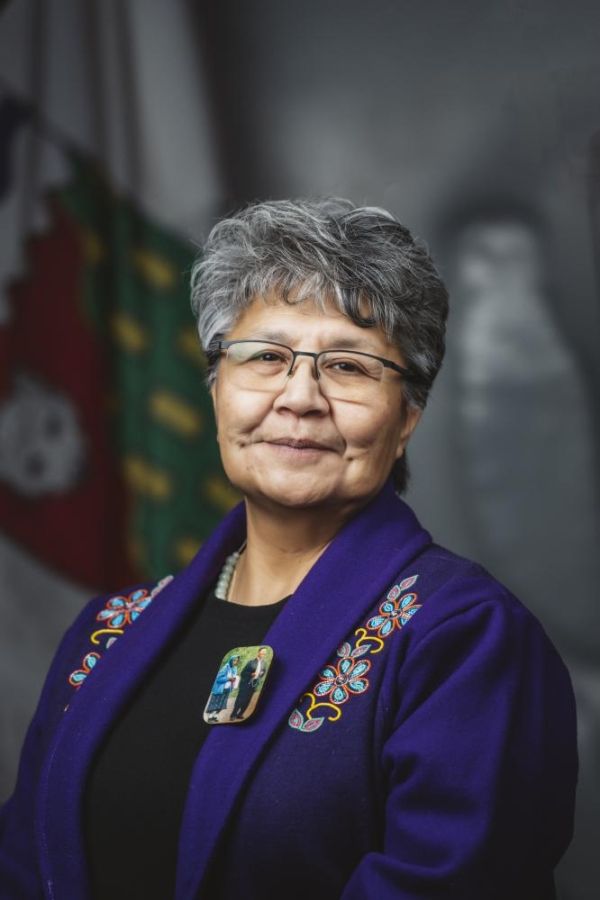
Jane Weyallon Armstrong
Monfwi
Bureau

Yellowknife NT X1A 2L9
Canada

P.O. Boîte
1320

Déclarations dans les débats

Debates of , 20th Assembly, 1st Session (day 61)

Thank you. Thank you, Mr. Speaker. Given that the $2 million federal territorial funding for transitional housing is limited, how does the Minister plan to prioritize or supplement this funding to meet the urgent need for temporary housing with wraparound support in regions like Tlicho?

Debates of , 20th Assembly, 1st Session (day 61)

Masi, Mr. Speaker. Mr. Speaker, [Translation] Masi, Mr. Speaker.  Today we have -- we have Lucy Lafferty.  She's a wife, and then she was a principal.  She was also a director of education and also the -- and also she is the coordinator.  She is very active for our language, Lucy -- Lucy Lafferty.  The interpreter -- the interpreter here Jonas that isn't here, Jonas Lafferty, his wife is also here, as I'd like to say -- I would like to say thank you to Lucy Lafferty.  And also the young people from Chief Jimmy Bruneau School here are also here, Shiloh Simpson and Nicoli Grosco, they are the...

Debates of , 20th Assembly, 1st Session (day 60)

Thank you, Mr. Speaker. Mr. Speaker, given the closure of community learning centres and the limited upgrading options available, how does the department plan to ensure that Indigenous students from small communities can meet post-secondary admission requirements without being forced to leave home or return to institutions they are not comfortable attending? Thank you.

Debates of , 20th Assembly, 1st Session (day 60)

Thank you, Mr. Speaker. Mr. Speaker, will the Minister commit to reviewing the current student financial assistance policy to allow students to receive funding for academic upgrading at institutions outside of Aurora College, either online or outside of the territory, so that our students with -- our students with financial assistance needs have a greater choice and access to quality education?

Debates of , 20th Assembly, 1st Session (day 60)

Thank you, Mr. Speaker. Mr. Speaker, I sympathize with my colleague, and I hear the concerns that have been raised. Mr. Speaker, as Members, we need to focus on cooperation and collaborations to make life better for residents across the Northwest Territories. Mr. Speaker, this motion includes strong recommendations. True progress depends not just on passing motions but on continued dialogue, accountability, and collaborative approach to problem solving.

Mr. Speaker, we all want the same thing, a better healthcare system for our people, especially in small communities.

Mr. Speaker, I want to...

Debates of , 20th Assembly, 1st Session (day 60)

Thank you. Thank you, Mr. Speaker. Can the Minister say what's step is the department taking to address the lack of financial support for part-time studies, especially for students on income support or those working full-time in small communities who want to pursue programs, like personal support worker training? Thank you.

Debates of , 20th Assembly, 1st Session (day 60)

Student financial assistance. Mr. Speaker, as another school year ends, I want to recognize the high school students graduating across the Northwest Territories. This is an exciting time for our young people, filled with hope and ambition, as they prepare to leave their communities to pursue post-secondary education. However, Mr. Speaker, the reality for Indigenous students in our smaller communities is more complicated. The education outcomes in small communities continue to fall behind those in our regional centres.

Mr. Speaker, too many of our graduates do not meet the entry requirement for...

Debates of , 20th Assembly, 1st Session (day 60)

Thank you, Mr. Speaker. Mr. Speaker, when people leak confidential information, there should be consequences, but our ability to express is another issue. From Indigenous perspective, as an Indigenous person, a woman, we finally got our voice. As a result of the colonization, it destroyed our language, culture, and way of life. For so long, the racist Indian Act had power and control over our life. Not only that, it discriminated more against the Indigenous women. With this in mind, Mr. Speaker, I do not support this motion. Thank you.

Debates of , 20th Assembly, 1st Session (day 59)

Mahsi, Mr. Speaker. Mr. Speaker, I'll do it in my language. [Translation] Mr. Speaker, I am thankful for this bill that is in front of us, and I support it. In today's society, there's so many changes in our lives.  With this Act, I am amazed at what the nurses go through.  I didn't realize they didn't have their own Act, and everyone else has their own collective agreement except for them.  So the MLA from Yellowknife North has presented this bill.  I support her.  

Mr. Speaker, we been aware of this situation for a long time in the North.  Some of us don't have doctors living in our...

Debates of , 20th Assembly, 1st Session (day 59)

Thank you. Thank you, Mr. Speaker. It's my understanding that some small communities do not have regular in-person access to counsellors who provide mental health supports. What steps is the department taking to address these gaps and ensure equitable access to this free service to all small communities across the Northwest Territories? Thank you.