


Jane Weyallon Armstrong

Député de Monfwi

Circonscription électorale de Monfwi

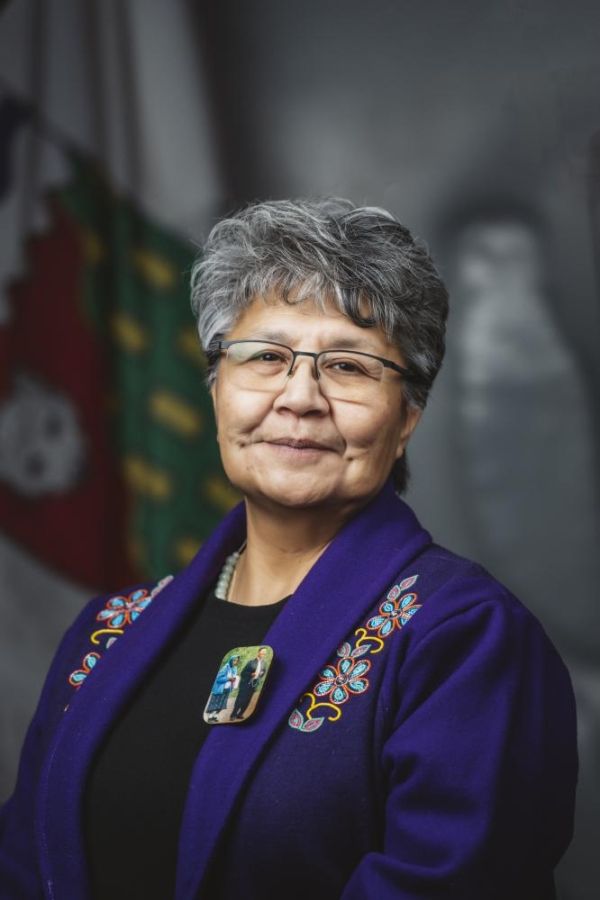
Jane Weyallon Armstrong a été élue députée de la circonscription de Monfwi à la 20e Assemblée législative des Territoires du Nord-Ouest. Jane Weyallon Armstrong a été élue à la 19e Assemblée lors d’une élection partielle pour représenter la circonscription de Monfwi. 

Elle est née à Fort Rae, aux Territoires du Nord-Ouest. Résidant actuellement à Behchoko, aux Territoires du Nord-Ouest, son parcours a laissé une trace indélébile dans sa collectivité. 

Ayant été présidente de l’Association des femmes autochtones de 2019 à 2021, Jane Weyallon Armstrong a collaboré avec les membres du conseil d’administration sur le rapport final de l’Enquête nationale sur les femmes et les filles autochtones disparues et assassinées. Son engagement pour la cause a joué un rôle majeur dans la résolution de problèmes cruciaux. 

La riche participation de Jane Weyallon Armstrong à la gouvernance de la collectivité comprend des rôles tels que conseillère à l’administration communautaire de Behchoko (2009-2013, 2017-2021, juin et juillet 2021) et membre de l’assemblée du gouvernement tłı̨chǫ (gouvernement de consensus) de 2009 à 2013. En outre, elle a siégé à l’Office d’examen des répercussions environnementales de la vallée du Mackenzie de 2020 à 2021. 

Avec une carrière de plus de 25 ans au Conseil scolaire de division des Dogrib (aujourd’hui l’Agence de services communautaires tłįchǫ), Jane Weyallon Armstrong a eu une incidence positive sur la vie d’élèves du secondaire issus de diverses collectivités. Ses fonctions de directrice de résidence, puis de coordonnatrice, d’agente de liaison et de responsable des services aux étudiants et d’aide à la transition après les études ont mis en évidence son dévouement à l’éducation et au développement de la collectivité. 

Jane Weyallon Armstrong a fait ses études secondaires à l’École Sir John Franklin à Yellowknife, et résidait à l’Akaitcho Hall. Elle a décroché un baccalauréat ès arts avec une majeure en politique et une mineure en études autochtones à l’université de la Saskatchewan. En 1994, elle a obtenu un diplôme de travailleuse sociale au Collège Aurora, au Campus Thebacha, et en 1992, un diplôme d’assistante sociale auprès des enfants et des jeunes au Mount Royal College. Jane Weyallon Armstrong a élevé sa fille avec son conjoint et se réjouit aujourd’hui d’être la fière grand-mère d’un petit-fils. Elle s’intéresse à la couture et à la lecture et participe à diverses activités culturelles. Son engagement de longue date en tant que bénévole pour des événements de collecte de fonds et des sorties scolaires souligne son dévouement pour le bien-être de la collectivité.

Committees
Jane Weyallon Armstrong
Monfwi
Bureau

Yellowknife NT X1A 2L9
Canada

P.O. Boîte
1320

Déclarations dans les débats

Debates of , 20th Assembly, 1st Session (day 22)

Madam Chair, Bill 2, missing Persons Act received second reading in the Legislative Assembly on February 26, 2024, and was referred to the Standing Committee on Social Development for review.

Throughout the committee's review, the committee met with the Minister of Justice, the Royal Canadian Mounted Police, and over 55 members of the public in three public hearings held in Aklavik, Inuvik and Yellowknife. The committee also received five written submissions on the bill.

On May 28, 2024, the standing committee held its clausebyclause review of the bill with the Minister of Justice. The committee...

Debates of , 20th Assembly, 1st Session (day 22)

Thank you, Mr. Speaker. Mr. Speaker, I also support this motion because this has an impact on my community and other Tlicho communities in the regions, and it also has an impact on the flyin community as well. So there is an increase in drug usage, and it is affecting a lot of our community members, the vulnerable people, the vulnerable and the children as well. So I do support this motion. Thank you.

Debates of , 20th Assembly, 1st Session (day 22)

Mr. Speaker, can the Minister explain if the department has any plan moving forward to help increase attendance rates in schools, especially in the small community? Thank you.

Debates of , 20th Assembly, 1st Session (day 22)

Yes, thank you, Mr. Speaker. Just like what Mr. Hawkins said, to my favorite Minister, ECE, but housing is still my favorite. So, Mr. Speaker, so this is for the ECE. Mr. Speaker, as I said in my Member's statement, attendance rates in small communities for junior kindergarten to grade 12 is on the downward trend when you look at the data over the last ten years. Aside from COVID19, can the Minister explain the reasons why school attendance rates are trending downward? Thank you.

Debates of , 20th Assembly, 1st Session (day 22)

Madam Chair, I move that this committee recommends the Government of the Northwest Territories provide a response to Committee Report 220(1), Standing Committee on Social Development Report on Bill 2: Missing Persons Act, within 120 days. Thank you, Madam Chair.

Debates of , 20th Assembly, 1st Session (day 22)

Can I have unanimous consent to conclude my statement? Thank you.

Life after high school is a choice young people must make, whether to pursue higher education, training, work, living life off the grid, or to travel, but travelling requires money to pay for the trips.

Mr. Speaker, according to the statistics, between 2017 to 2021, small community attendance rates for grade 9 dropped by 10 point from 79 to 69, an even bigger decline is between 2012 to 2021 where small community attendance rate for grade 6 dropped by 21 points from 89 to 68 percent. That is an alarming rate. These are extremely...

Debates of , 20th Assembly, 1st Session (day 21)

It's good, thank you. Thank you for the information, which I'm sure there's people listening and our leaders are listening too as well. So it's good to know that number.

And, yeah, so minority language education a second language, well, that's for French. But I know it was in the budget that Aurora College was going to be or it was part of their budget where they were going to deliver a diploma program for language. Why that program never went further or, like, it was never the department never did anything about it knowing the importance of the Indigenous language and, you know and now that...

Debates of , 20th Assembly, 1st Session (day 21)

Thank you. Yeah, no, I know many of these programs that I know that our constituents use these funds for culture and language. So it is important for them. That's how we maintain and try to keep our culture and language, you know, going. Because just like my colleague from Mackenzie Delta said, you know, it's  it does have an impact, you know, now that younger generation are not speaking the language more. So it is important that it  it would have been nice if there was  if the budget was a little bit more than as it is here, especially for Indigenous language, knowing that there's more...

Debates of , 20th Assembly, 1st Session (day 21)

Thank you. My question was regarding what MLA Morgan was referring to, education authority contributions. It says that, you know, money is allocated based on previous school year. So it is based on enrolment formula. So I just wanted to ask the Minister if there's a breakdown of regions, you know, which region is most impacted that, you know, there is a decrease in this budget. So, yeah, just which region is most impacted?

Debates of , 20th Assembly, 1st Session (day 21)

Well, I see here Indigenous scholarship. I guess that must be part of  that's part of the revitalization education program. So I think maybe if the Minister can explain a bit about this Indigenous scholarship.