


R.J. Simpson

Député de Hay River Nord

Premier ministre
Ministre de l’Exécutif et des Affaires autochtones

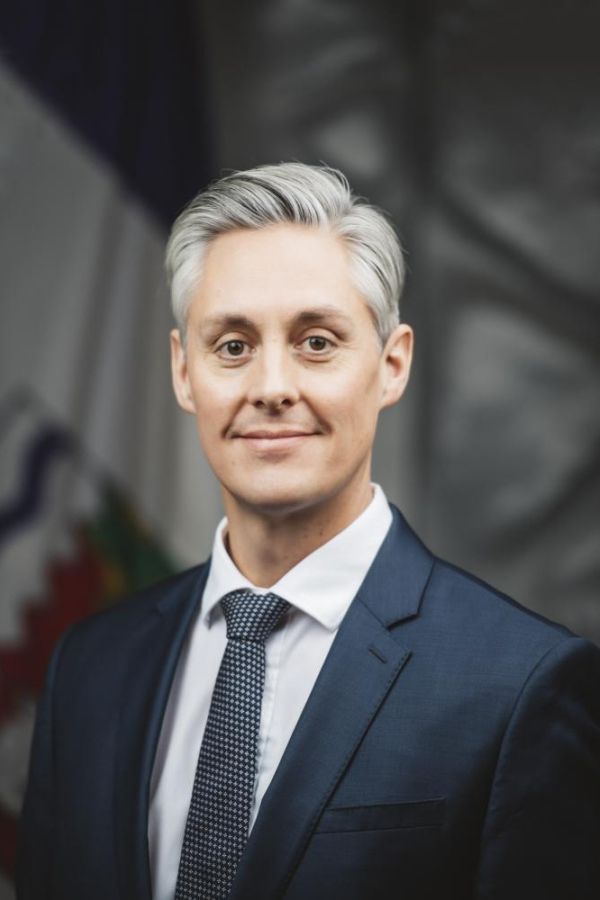
R.J. Simpson a été élu à la 20e Assemblée, représentant la circonscription de Hay River Nord. Le 7 décembre 2023, M. Simpson a été élu premier ministre de la 20e Assemblée législative des Territoires du Nord-Ouest.

M. Simpson a été élu par acclamation à la 19e Assemblée législative et élu pour la première fois à la 18e Assemblée en 2015.

M. Simpson a été élu pour la première fois à la 18e Assemblée législative en 2015. M. Simpson a été président adjoint de la 18e Assemblée législative, vice-président du Comité permanent des opérations gouvernementales et président du Comité spécial sur les questions de transition. M. Simpson a également siégé au Comité permanent des priorités et de la planification, de même qu’au Comité permanent du développement économique et de l’environnement.

M. Simpson a habité à Hay River toute sa vie. Après avoir obtenu son diplôme d’études secondaires à l’école secondaire Diamond Jenness en 1998, il a décroché un baccalauréat ès arts à l’Université MacEwan et un diplôme en droit à la faculté de droit de l’Université de l’Alberta.

M. Simpson a précédemment travaillé pour le gouvernement du Canada, la Northern Transportation Company limitée, la section locale no 51 des Métis, et Maskwa Engineering.

Pendant ses études en droit, M. Simpson a été président de l’association des étudiants en droit autochtones. Il a également siégé au conseil d’administration du Centre d’amitié Soaring Eagle, à Hay River, et donne de son temps au projet d’éducation Canada-Ghana.
R.J. Simpson
Hay River Nord
Bureau

Yellowknife NT X1A 2L9
Canada

P.O. Boîte
1320
Extension
11120
Bureau de circonscription

62, promenade Woodland, bureau 104
Hay River Nord NT X0E 1G1
Canada

Phone
Bureau de la ministre

Déclarations dans les débats

Debates of , 20th Assembly, 1st Session (day 86)

Thank you, Mr. Chair. So I think there is an opportunity to look at the direction that is provided to the officials at that table on the GNWT side. I think government sort of moves at a certain pace, but there's clearly a desire from the Assembly, and I know from Cabinet, to move more quickly on things. And I think that might fall under the category of providing more leadership. Because the Member's right, we do have more resources. You know, we've -- so, I am trying to avoid talking about the GNWT as being the boss at the table and being able to push things through against the wishes of...

Debates of , 20th Assembly, 1st Session (day 86)

Thank you. And so the IGC is set up through the NWT intergovernmental agreement on lands and resource management through the devolution agreement, so that's sort of the primary framework. In terms of GNWT-specific policy documents, direction, we do have the legislative development protocol on how we work with Indigenous governments. But if the Member is talking about, on a specific issue, how do -- what direction is given to advance a specific issue or a specific file, well, that would be then what's the issue, what's the file. If there's political direction or a desire on Cabinet's part to...

Debates of , 20th Assembly, 1st Session (day 86)

Thank you. So from what I understand, the GNWT has responsibilities over lands and resources, and there's a desire on behalf of Canada to have the partner who has that responsibility and that awareness of the situation at the table. Thank you.

Debates of , 20th Assembly, 1st Session (day 86)

Thank you, Madam Chair. And I want to be careful not to try to -- or be seen as negotiating on the floor of the House. Like those types of discussions need to happen at the negotiation table. But there are disagreements about -- or not disagreements. There is differences of opinion on some significant issues related to land and wildlife and some of these things. But that being said, we are making progress on those and there is progress in other areas as well. The Dehcho are very committed to advancing this, and so are we. And so we're seeing progress. As I've said, I've had a number of...

Debates of , 20th Assembly, 1st Session (day 86)

I do.

Debates of , 20th Assembly, 1st Session (day 86)

Thank you, Mr. Speaker. I'd like to recognize some pages that we've had here from Hay River for the week. Natalie Boucher from Hay River North, as well as Kennedy Bolt and Malikai Beaulieu from Hay River South. We're always happy to have the youth in the chamber, and I hope they learned something. Thank you.

Debates of , 20th Assembly, 1st Session (day 86)

Thank you, Mr. Chair. So there is no plan currently to make that change. We have not heard that there are workload issues that would require additional time. I understand what the Member is saying, though, that maybe some times of day are less convenient for some residents than other times of day. But given the workload, the plan is to continue forward as a part-time position. Thank you.

Debates of , 20th Assembly, 1st Session (day 85)

Thank you, Madam Chair. And, you know, as was mentioned earlier, there's programs that we're always going to have that every jurisdiction in Canada delivers and, you know, on the list of programs that are being reviewed, that's primarily what we have. And so we know that, you know, medical travel is going to, you know, be core in the territory. We're going to need medical travel. We have a big territory. We have a lack of infrastructure. We're going to need medical travel. Are we doing it as efficiently as possible? I would say we're not. I mean -- and there are anecdotal -- you know, the...

Debates of , 20th Assembly, 1st Session (day 85)

Thank you. I wouldn't say there's a lot of granularity. We don't want it to be too specific but we want it to be high level. But, you know, I mentioned that there's always something new and just recently we saw the defence industrial strategy, which is actually quite a significant component of the military investment in the coming years. And so even having that information, knowing what's in there, what the DND's plans are going forward has been helpful. And so it's incorporating things like that which aren't necessarily highly specific, but are still highly important. Thank you.

Debates of , 20th Assembly, 1st Session (day 85)

Thank you. So case management is what the teams are working on. So when in -- and this has been happening informally in some places around the territory. I know Hay River's on and off had integrated service delivery -- or sorry, integrated case management, unofficially. What we're doing now is making it official, and there's a structure around it. So when there's a client who is facing barriers, the team gets together, they can talk about that client, and they can then -- in the old days, they would work to address that client's needs. Now they can continue to address that client's needs, but...