


R.J. Simpson

Député de Hay River Nord

Premier ministre
Ministre de l’Exécutif et des Affaires autochtones

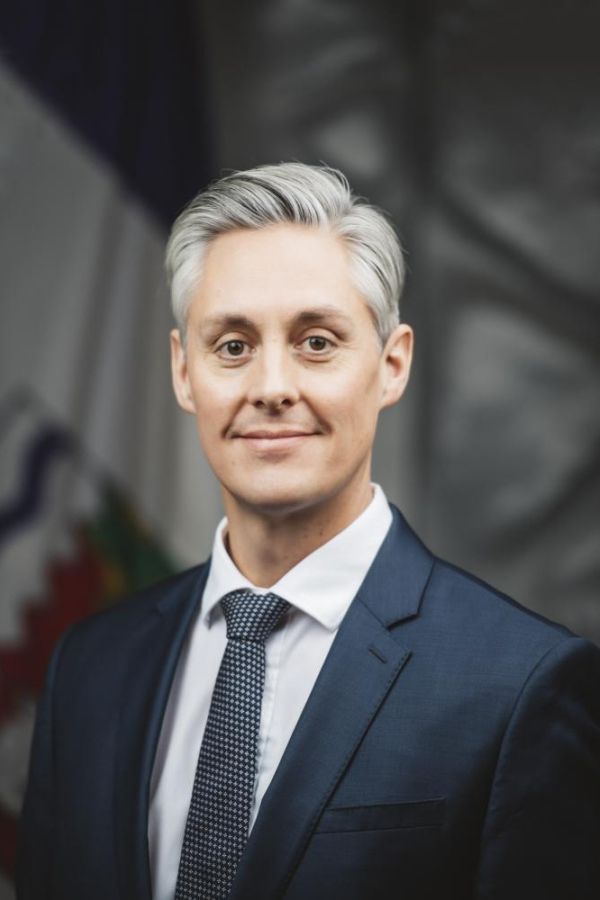
R.J. Simpson a été élu à la 20e Assemblée, représentant la circonscription de Hay River Nord. Le 7 décembre 2023, M. Simpson a été élu premier ministre de la 20e Assemblée législative des Territoires du Nord-Ouest.

M. Simpson a été élu par acclamation à la 19e Assemblée législative et élu pour la première fois à la 18e Assemblée en 2015.

M. Simpson a été élu pour la première fois à la 18e Assemblée législative en 2015. M. Simpson a été président adjoint de la 18e Assemblée législative, vice-président du Comité permanent des opérations gouvernementales et président du Comité spécial sur les questions de transition. M. Simpson a également siégé au Comité permanent des priorités et de la planification, de même qu’au Comité permanent du développement économique et de l’environnement.

M. Simpson a habité à Hay River toute sa vie. Après avoir obtenu son diplôme d’études secondaires à l’école secondaire Diamond Jenness en 1998, il a décroché un baccalauréat ès arts à l’Université MacEwan et un diplôme en droit à la faculté de droit de l’Université de l’Alberta.

M. Simpson a précédemment travaillé pour le gouvernement du Canada, la Northern Transportation Company limitée, la section locale no 51 des Métis, et Maskwa Engineering.

Pendant ses études en droit, M. Simpson a été président de l’association des étudiants en droit autochtones. Il a également siégé au conseil d’administration du Centre d’amitié Soaring Eagle, à Hay River, et donne de son temps au projet d’éducation Canada-Ghana.
Committees

R.J. Simpson
Hay River Nord
Bureau

Yellowknife NT X1A 2L9
Canada

P.O. Boîte
1320
Extension
11120
Bureau de circonscription

62, promenade Woodland, bureau 104
Hay River Nord NT X0E 1G1
Canada

Phone
Ministre
Premier ministre des Territoires du Nord-Ouest, Ministère de l’Exécutif et des Affaires autochtones, Ministre de la Justice

Déclarations dans les débats

Debates of , 20th Assembly, 1st Session (day 61)

Thank you, Mr. Speaker. And so that question really gets to integrated service delivery. And so we are advancing integrated service delivery across the territory. We're starting small. Once again. We don't want to try and do this all at once. We want to learn lessons on how we can better work together and better empower employees to make decisions that are in the best interests of residents and aren't administratively burdensome. So we're establishing regional locations in five communities to explore how to reduce the regulatory and policy burden on both the public service and the residents...

Debates of , 20th Assembly, 1st Session (day 61)

Thank you, Mr. Speaker. So I'll answer one of the questions in there. So what's happening now is that the different entities who are involved in this are meeting. The Government of the Northwest Territories, the city of Yellowknife, the RCMP, a number of different organizations are all meeting. Everyone is coordinating, putting their mind towards this issue. We are looking at more suitable locations and then working with the folks at the encampment and their legal representatives to try and relocate to those suitable locations. And we're identifying any other barriers that might exist, any...

Debates of , 20th Assembly, 1st Session (day 61)

Thank you, Mr. Speaker. There's no delay. The work is happening right now. Thank you.

Debates of , 20th Assembly, 1st Session (day 61)

Thank you, Mr. Speaker. Yes, as I mentioned yesterday, understanding that even with adequate space there will be encampments, we want to ensure that where those encampments might set up are places that are not disruptive to neighbourhoods, and so we are looking at different locations around the city trying to figure out where might be an appropriate location, then the plan is to try and work with those at the encampments and their legal representatives to try and relocate them to a more suitable location. Thank you.

Debates of , 20th Assembly, 1st Session (day 61)

Mr. Speaker, I am pleased to share that the Government of the Northwest Territories has launched this year's United Way Workplace Giving Campaign. This annual campaign gives GNWT employees a simple and meaningful way to support programs that make a real difference in communities across the territory. Through payroll deductions, employees can choose to direct donations to United Way NWT, helping fund local organizations that tackle poverty, support youth, and improve community health and well-being.

Mr. Speaker, over the past few years, Northerners have come together during some very difficult...

Debates of , 20th Assembly, 1st Session (day 61)

Thank you, Mr. Speaker. So some of these sort of cut across different departments. Maybe the Minister of Finance might be more appropriate to answer that. So what I'll do is I'll let -- I'll tell the Member I'll have to get back to him on that one. Thank you.

Debates of , 20th Assembly, 1st Session (day 61)

Thank you, Mr. Speaker. And it might not sound like a big question, but that's a big question. We're talking about a culture change in had the government, really, and how we do business across government. But I'm happy to report that there are a number of initiatives underway. So I'll just start with something simple.

Sometimes streamlining just means defining roles so people actually know what their role is relative to other departments and enabling departments to work together with that understanding. And so one thing that we have started doing is creating project charters when there is an...

Debates of , 20th Assembly, 1st Session (day 61)

Thank you, Mr. Speaker. I'm not -- I haven't been a part of those conversations with the legal representatives. I haven't actually gone down to the encampment and spoken with the folks there. So I can't tell the Member or the House what their desire is to move at this point. Maybe they have no plans to move and even if we had a great spot for them, they wouldn't want to go. So I can't make any commitment about what a private citizen is going to do. Thank you.

Debates of , 20th Assembly, 1st Session (day 60)

Thank you, Mr. Speaker. Yes, all of those things. So, you know, the population of individuals who are unhoused, you know, they come and go. They don't have fixed addresses obviously, and so just knowing where people are at any given time can be difficult. And so that's, you know, the most fundamental issue that we have. There is things like the Health Information Act which is one of our two pieces of privacy legislation here in the territory, and that puts a lot of boundaries around who information can be shared with, who can hold on to that information, and that can make it difficult when we...

Debates of , 20th Assembly, 1st Session (day 60)

Thank you, Mr. Speaker. So noting that there will be a full review -- or sorry, a report back on the recommendations, I can note a few things.

So one of the -- obviously, one of the very first things was the realization that fire seasons start earlier than ever and so because of that, the GNWT has been bringing on fire crews, aircraft, seasonal wildfire personnel, earlier than they were before, and there's been significant investments made in mitigation and prevention efforts.

We've been working with Indigenous governments. We heard in the last -- during the 2023 evacuations that Indigenous...